
SUSTAINABILITY PERFORMANCE DASHBOARD
In this section:
Summary
Environmental Metrics
Social Metrics
From our environmental program to our social metrics, our data dashboard provides supplemental information about HBI’s sustainability strategy.
Reporting on Our Progress
In 2024, we made strong progress against our prior goals. To find out more, download our sustainability summary report.
In 2025, we set new 2030 goals around our three sustainability pillars. To learn more about our new goals, visit our People, Planet and Product pages.
Environmental Metrics
We have made significant progress since we began formally tracking and reporting our energy use (including renewables), greenhouse gas emissions, water use, and waste generated/diverted from landfills. Below are the details outlining our performance on a broad range of metrics.
CLIMATE
| METRIC | 2019 BASELINE | 2023 | 2024 |
|---|---|---|---|
| SCOPE 1 AND 2 GHG EMISSIONS* | |||
| Absolute Scope 1 GHG's (metric tons CO2e)* |
89,357 | 39,516 | 43,248 |
| Absolute Scope 2 GHG's (metric tons CO2e)* |
128,184 | 66,078 | 56,827 |
| Total Scope 1 & 2 Absolute GHG Emissions (metric tons CO2e) |
217,541 | 105,594 | 100,075 |
| % Absolute Scope 1 & 2 GHG Variation (from 2019 baseline)* |
0.0% | -51.5% | -54% |
| Scope 1 & 2 GHG Emissions Intensity (kg CO2e per finished textile pound) |
0.77 | 0.46 | 0.443 |
| % Scope 1 & 2 GHG Intensity Variation (from 2019 baseline) |
0.0% | -40.0% | -42.5% |
| SCOPE 3 GHG EMISSIONS* | |||
| Absolute Scope 3 Emissions (metric tons CO2e) |
2,411,642 | 1,820,527 | 1,838,965 |
| % Absolute Scope 3 GHG Variation (from 2019 baseline) |
0.0% | -24.5% | -23.7% |
| SCOPE 3 GHG EMISSIONS BY CATEGORY* | |||
| 1. Purchased Goods & Services* | 1,586,610 | 1,245,574 | 1,284,863 |
| 2. Capital Goods | 24,018 | 10,984 | 1,493 |
| 3. Fuel & Energy Emissions | 48,559 | 47,467 | 46,799 |
| 4. Upstream Transportation* | 309,519 | 124,617 | 155,198 |
| 5. Waste from Operations | 4,526 | 2,254 | 2,246 |
| 6. Business Travel | 8,164 | 6,046 | 4,322 |
| 7. Employee Commuting | 78,856 | 63,376 | 56,163 |
| Work from Home (location-based) |
653 | 2,665 | 2,275 |
| 8. Upstream Leased Assets | 37,927 | 29,374 | 15,516 |
| 9. Downstream Transportation | 213,671 | 213,615 | 207,982 |
| 12. End of Life | 99,139 | 74,556 | 62,107 |
| SCOPE 3 GHG EMISSIONS WITHIN THE BOUNDARIES OF OUR SCIENCE BASED TARGETS (CATEGORIES 1 AND 4)* | |||
| Absolute Scope 3 Emissions for SBT (metric tons CO2e)* |
1,896,129 | 1,370,191 | 1,440,061 |
| % Absolute Scope 3 GHG Variation for SBT (from 2019 baseline)* |
0.0% | -27.7% | -24.1% |
| CDP | |||
| Climate Disclosure Score | Not Applicable | A- | A- |
| Water Disclosure Score | Not Applicable | A- | A- |
| Forests Disclosure Score | Not Applicable | C | B |
| HIGG FEM | |||
| Owned and Contractor Facilities that have completed the Higg FEM self-assessment | Not Applicable | 406 | In Progress |
| Owned and Contractor Facilities that have completed the Higg FEM verification | Not Applicable | 305 | In Progress |
| *We use a hybrid method approach following GHG protocol guidelines to calculate our annual carbon emissions. GHG emissions in the scope of science-based targets are third-party verified. | |||
ENERGY
| METRIC | 2019 BASELINE | 2023 | 2024 |
|---|---|---|---|
| ENERGY CONSUMPTION | |||
| Absolute Energy (million BTUs) |
3,211,761 | 2,722,988 | 2,604,723 |
| Energy Intensity (MMBTUs per thousand finished textile pounds) |
11.367 | 11.572 | 11.530 |
| Energy Intensity Variation (from 2019 baseline) |
0.0% | 2.00% | 1.44% |
| % Renewable Energy (% of total energy portfolio that is renewable) |
43.1% | 53% | 66.10% |
| % Electricity of Total Energy | 38.7% | 38% | 45.8% |
| % Renewable Electricity of Total Electricity | 44.7% | 59% | 66.7% |
WATER
| METRIC | 2019 BASELINE | 2023 | 2024 |
|---|---|---|---|
| WATER CONSUMPTION | |||
| Total Water Use (thousands of gallons) |
2,371,657 | 1,705,965 | 1,537,629 |
| Water Use Intensity (gallons per finished textile pound) |
8.392 | 7.492 | 6.806 |
| % Water Use Intensity Variation (from 2019 baseline) | 0.0% | -10.70% | -18.91% |
WASTEWATER
| METRIC | 2019 BASELINE | 2023 | 2024 |
|---|---|---|---|
| WASTEWATER TREATMENT | |||
| Total volume of water treated in our internal wastewater treatment facilities (thousands of gallons) |
Not Applicable | N/A | 1,200,711 |
| El Salvador WWTP (thousands of gallons) |
Not Applicable | N/A | 635,601 |
| Dominican Republic WWTP (thousands of gallons) |
Not Applicable | N/A | 557,772 |
| Brazil WWTP (thousands of gallons) |
Not Applicable | N/A | 7,338 |
SOLID WASTE
| METRIC | 2019 BASELINE | 2023 | 2024 * |
|---|---|---|---|
| TOTAL WASTE | |||
| Total Waste Generated from Operations (lbs.) |
114,094,042 | 99,784,087 | 164,176,477 |
| Total Waste Diverted from Landfill (lbs.) |
101,302,464 | 93,111,383 | 161,891,678 |
| % Landfill Diversion Rate | 88.79% | 93.31% | 98.61% |
| LANDFILL DIVERSION RATES BY LOCATION | |||
| % Landfill Diversion Rate - Asia | Not Applicable | 98.11% | 100.00% |
| % Landfill Diversion Rate - Caribbaen | Not Applicable | 95.97% | 99.58% |
| % Landfill Diversion Rate - Honduras | Not Applicable | 86.65% | 98.00% |
| % Landfill Diversion Rate - El Salvador | Not Applicable | 93.39% | 98.21% |
| % Landfill Diversion Rate - South America | Not Applicable | N/A | 100.00% |
| % Landfill Diversion Rate - Australasia (excl. stores) |
Not Applicable | 95.27% | 95.63% |
| % Landfill Diversion Rate - North America (excl. stores) |
Not Applicable | 82.99% | 98.18% |
| TOTAL WASTE BY DISPOSAL METHOD | |||
| % Landfill | Not Applicable | 6.69% | 1.39% |
| % Reuse | Not Applicable | 93.31% **| 3.38% |
|
| % Recycle | Not Applicable | 84.33% | |
| % Downcycle | Not Applicable | 5.57% | |
| % Other (Energy Recovery, Residual Management, etc.) |
Not Applicable | 5.32% | |
| TOTAL DIVERTED WASTE BY MATERIAL | |||
| % Diverted - Textile/Thread | Not Applicable | N/A | 36.19% |
| % Diverted - Carton/Corrugate | Not Applicable | N/A | 48.53% |
| % Diverted - Plastic | Not Applicable | N/A | 7.36% |
| % Diverted - Other | Not Applicable | N/A | 7.92% |
| *In 2024 we refreshed our waste policy and standardized our waste data collection methodology.
**Combined total of Reuse, Recycle, Downcycle and Other disposal methods. |
|||
COMMUNITY ENGAGEMENT AND PHILANTHROPY
| METRIC | 2019 BASELINE | 2023 | 2024 |
|---|---|---|---|
| LIVES IMPACTED | |||
| Lives Impacted (associates, their families, and communities) |
Not Applicable | 687,410 | 443,624 |
| Units of Products Donated | Not Applicable | 3,578,940 | 1,378,995 |
| HEALTH SERVICES | |||
| Surgeries provided during medical brigades* | Not Applicable | 132 | 165 |
| Medical consultations provided during medical brigades and health fairs* | Not Applicable | 318 | 375 |
| EDUCATION | |||
| Total Associate Development Hours | Not Applicable | N/A | 11,000 |
| Total Associates Enrolled in Education Programs | Not Applicable | 4,000| 2,000 |
|
| Total Associates Graduating from HBI sponsored programs | Not Applicable | 707 | 824 |
| High School Diplomas | Not Applicable | 224 | 157 |
| Technical Schools | Not Applicable | 445 | 642 |
| College Degrees | Not Applicable | 38 | 25 |
| *These activities count towards our total lives impacted metric. | |||
HEALTH AND SAFETY
| METRIC | 2019 BASELINE | 2023 | 2024 |
|---|---|---|---|
| GLOBAL SAFETY DATA | |||
| OSHA Total Recordable Incident Rate | Not Applicable | 0.34 | 0.29 |
| Number of Fatalities | Not Applicable | 0 | 0 |
| Number of Recordable Incidents | Not Applicable | 165 | 133 |
| Number of First Aid Incidents | Not Applicable | 673 | 550 |
| Number of Near Miss Incidents | Not Applicable | 4,023 | 5,356 |
| INCIDENT RATES BY LOCATION | |||
| Incidence Rate - Asia Supply Chain | Not Applicable | 0.02 | 0.01 |
| Incidence Rate - Central America and the Caribbean Supply Chain | Not Applicable | 0.12 | 0.10 |
| Incidence Rate - Latin America Supply Chain | Not Applicable | 0.61 | 1.13 |
| Incidence Rate - North America Supply Chain | Not Applicable | 1.79 | 1.26 |
| Incidence Rate - Australasia Supply Chain | Not Applicable | 2.10 | 4.17 |
| Incidence Rate - Administrative Offices & Retail Stores | Not Applicable | 0.88 | 0.91 |
| INCIDENT RATES BY OPERATION TYPE | |||
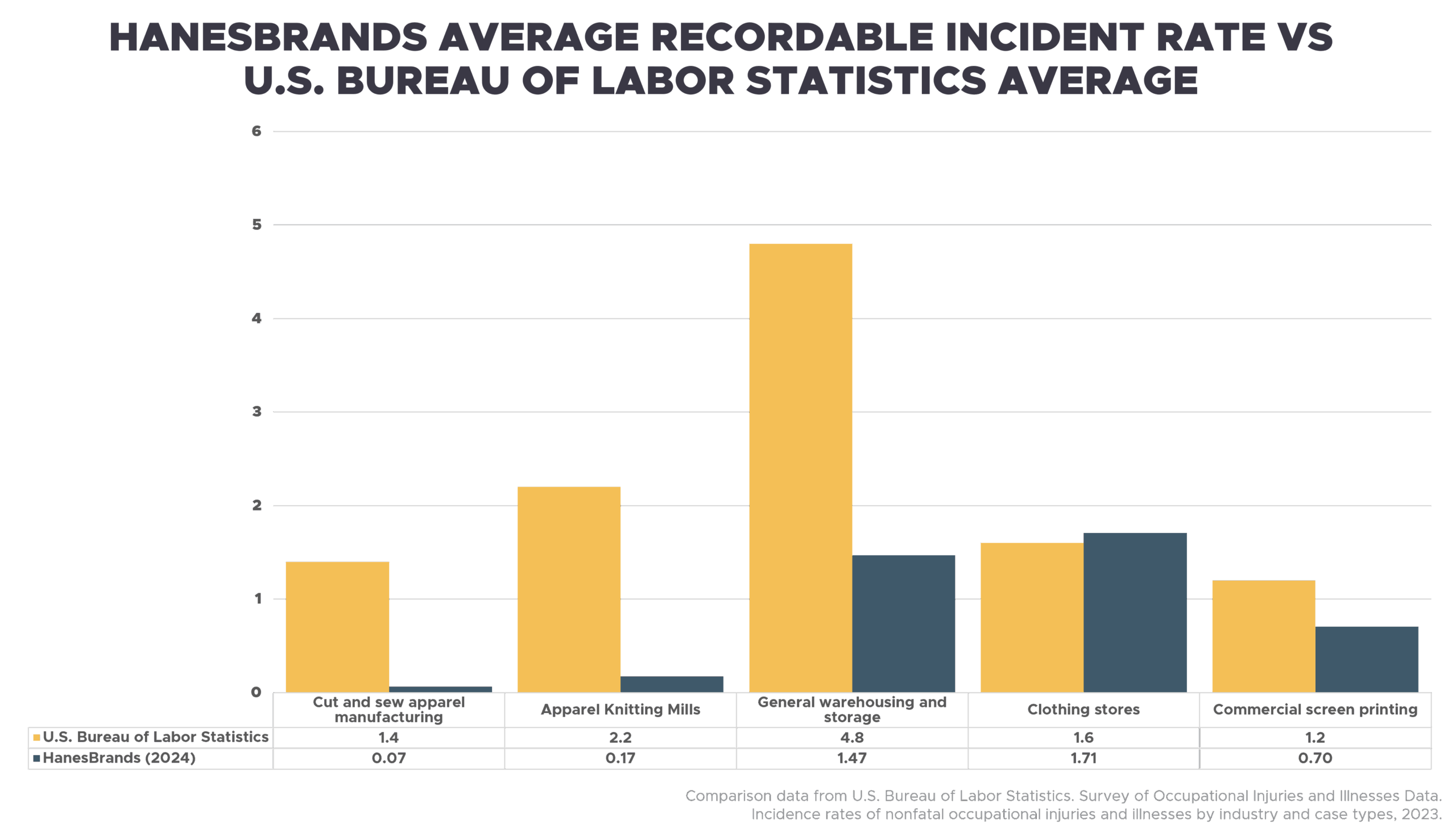
| Cut and Sew Apparel Manufacturing | Not Applicable | 0.07 | 0.07 |
| Apparel and Knitting Mills | Not Applicable | 0.23 | 0.17 |
| General Warehousing and Storage | Not Applicable | 1.69 | 1.47 |
| Clothing Stores | Not Applicable | 1.61 | 1.71 |
| Commercial Screen Printing | Not Applicable | 0.84 | 0.70 |
Compliance Status Chart
As of 03/15/2025
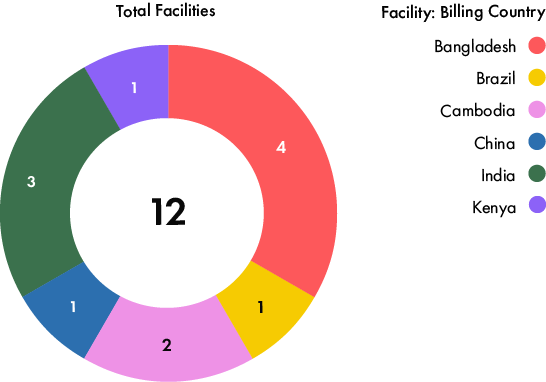
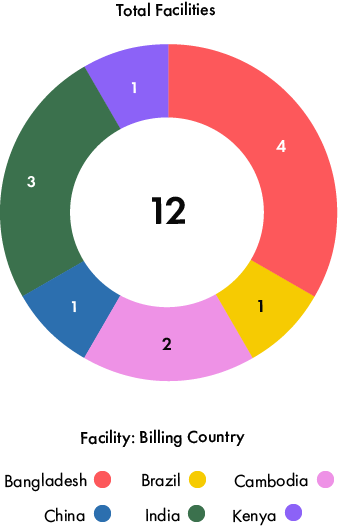
Facility Alarm By Country
As of 03/15/2025
Factory Performance
To effectively audit and manage a truly global supplier network, we use an in-depth, scored audit protocol of 225 questions encompassing a broad range of issues including management systems, health and safety compliance, responsible labor practices, environmental compliance and facility/product security. We detail our full audit protocol in our Global Standards For Suppliers (GSS). Our GSS Vendor Manual also details our auditing and corrective action process.
Each question is scored on a 0-3 scale with specific criteria identified to attain each score. A score of 1 is considered substandard, 2 is considered as meeting expectations, and 3 signals best practice. When the scores are rolled-up and averaged, an average score of 2 on a 100-point scale equates to a score of 66.
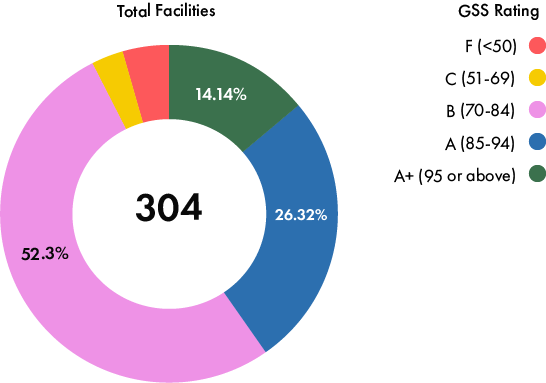
Based on this scoring methodology, facilities with a total score of 95 and above are deemed “A+: Far Exceeds Expectations,” between 85 and 94 “A: Exceeds Expectations,” between 70-84 “B: Meets Expectations,” between 51 and 69 “C: Below Expectations,” and 50 and below “F; Unsatisfactory.” These facilities are placed on our Alarm List.
Between our owned, contractor and licensee facilities, we are currently monitoring 304 sewing, decoration and textile facilities. To the left is the breakdown of these facilities by compliance status. About 93% of facilities score B or above – a 2% increase from last year.
The sourcing teams have real-time access to this data, including those on the Alarm List. The compliance/sustainability and sourcing teams work closely to immediately remediate these Alarm List factories or quickly develop exit plans.
We track the score of a facility over time, and use facility scores in making sourcing decisions. The average score for the latest audit of our owned facilities is 94%, over 14 points higher than the contractor average (80%), and 21 points above the licensee average (73%). Owning our facilities is an advantage in ensuring our factories are performing at an A level. We are committed to working with licensed facilities to increase their scores and match our standards.
Factory Performance
To effectively audit and manage a truly global supplier network, we use an in-depth, scored audit protocol of over 2600 questions encompassing a broad range of issues including management systems, health and safety compliance, responsible labor practices, environmental compliance and facility/product security. We detail our full audit protocol in our Global Standards For Suppliers (GSS). Our GSS Vendor Manual also details our auditing and corrective action process.
Each question is scored on a 0-3 scale with specific criteria identified to attain each score. A score of 1 is considered substandard, 2 is considered as meeting expectations, and 3 signals best practice. When the scores are rolled-up and averaged, an average score of 2 on a 100-point scale equates to a score of 66.
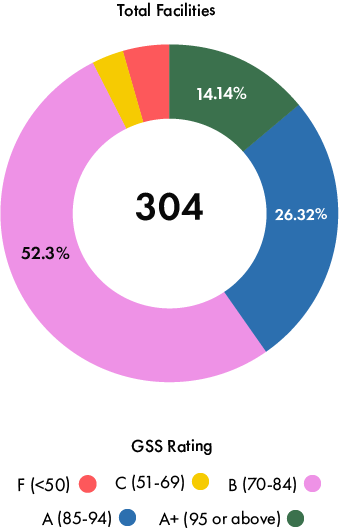
Based on this scoring methodology, facilities with a total score of 95 and above are deemed “A+: Far Exceeds Expectations,” between 85 and 94 “A: Exceeds Expectations,” between 70-84 “B: Meets Expectations,” between 51 and 69 “C: Below Expectations,” and 50 and below “F; Unsatisfactory.” These facilities are placed on our Alarm List.
Between our owned, contractor and licensee facilities, we are currently monitoring 532 sewing, decoration and textile facilities. To the left is the breakdown of these facilities by compliance status. Over 91% of facilities score B or above – an 8% increase from last year.
The sourcing teams have real-time access to this data, including those on the Alarm List. The compliance/sustainability and sourcing teams work closely to immediately remediate these Alarm List factories or quickly develop exit plans.
We track the score of a facility over time, and use facility scores in making sourcing decisions. The average score for the latest audit of our owned facilities is 94%, over 14 points higher than the contractor average (80%), and 21 points above the licensee average (73%). Owning our facilities is an advantage in ensuring our factories are performing at an A level. We are committed to working with licensed facilities to increase their scores and match our standards.
Compliance Status Chart
As of 03/15/2025
Facility Alarm By Country
As of 03/15/2025
Average GSS Score By Country (Top 11)
As of 03/15/2025
- Honduras A+ 99%
- Dominican Republic A+ 98%
- Nicaragua A+ 97%
- Turkey A+ 96%
- El Salvador A+ 96%
- Jordan A 94%
- Philippines A 93%
- Pakistan A 93%
- Egypt A 92%
- Italy A 92%
- Australia A 92%
Average GSS Score By Facility Type
As of 03/15/2025
- HanesBrands Owned A 94%
- Contractors B 80%
- Licensees B 73%
Average GSS Score By Audit Type for 2024
- Annual B 73%
- Remediation C 68%
- Initial C 59%
GSS Audits By Employee Group
As of 03/15/2025
- 1000+ B 82%
- 500 to 999 B 79%
- 100 to 499 B 80%
- Less than 100 B 73%
Average GSS Score By Country (Top 11)
As of 03/15/2025
- Honduras A+ 99%
- Dominican Republic A+ 98%
- Nicaragua A+ 97%
- Turkey A+ 96%
- El Salvador A+ 96%
- Jordan A 94%
- Philippines A 93%
- Pakistan A 93%
- Egypt A 92%
- Italy A 92%
- Australia A 92%
Average GSS Score By Facility Type
As of 03/15/2025
- HanesBrands Owned A 94%
- Contractors B 80%
- Licensees B 73%
Average GSS Score By Audit Type for 2024
- Annual B 73%
- Remediation C 68%
- Initial C 59%
GSS Audits By Employee Group
As of 03/15/2025
- 1000+ B 82%
- 500 to 999 B 79%
- 100 to 499 B 80%
- Less than 100 B 73%
Safety Data
The safety of our associates and those of the contractors who make our product is of paramount importance to us. As an apparel manufacturer for over 100 years, we know how to operate facilities safely, and we know the standards to which we should hold others.
Please see below data showing our recordable/incident rates that are significantly below Bureau of Labor Statistics averages.
We also rigorously audit against health and safety issues in our owned and contractor facilities as part of our GSS auditing program. Of the 225 questions in our audit protocol, 101 are focused on health and safety issues – with a particular emphasis on fire safety – a critical issue in the apparel industry.
Zero tolerance issues such as locked fire doors, blocked exits, or the lack of multiple escape routes place the facility on our Alarm List which requires immediate remediation or withdrawal from the facility.
Social Metrics
From community engagement and philanthropy to our safety programs, we aim to be transparent and share relevant data more broadly. Please see below for more specific disclosures: